
These case studies highlight real‑world examples of how lived and living experience has informed the design and delivery of local drug and alcohol services across Scotland.
Their purpose is to:
- Support learning, reflection, and improvement
- Help inform service design of recovery-oriented drug and alcohol services.
Healthcare Improvement Scotland was not directly involved in delivering these projects, the content has been provided by the organisations and teams leading the work and reflects their own experiences, approaches, and impact.
Moray Alcohol and Drug Partnership recovery model
This case study examines how action by leadership in Moray Alcohol and Drug Partnership (ADP) has to improved outcomes across a mostly rural locality. This includes the involvement of those with lived-experience in planning and decision making.
Background
Rural communities can face many challenges in accessing alcohol and drug related support. These include long travel distances, limited public transport, stigma, and fewer local services. Barriers like these can delay continuity of care, and isolate people in recovery.
This case study examines how action by leadership within the Moray Alcohol and Drug Partnership (ADP), contributed to improved engagement and recovery outcomes.
The key element in Moray has been embedding lived experience involvement into planning and decision making. This has improved access and pathways to recovery services as well as outreach and support for rural communities.
Key Learning

Allow communities to define services
People who know and understand their own communities and use services are best placed to influence how they should operate. Involving people in the design of specifications can build trust that is often lacking and thus help to empower people and communities a whole. This element is key to Moray ADPs overall philosophy.
Be adaptable and open to change
Never feel that things should be set in stone. Aim for ongoing evaluation to judge how services can improve and adapt to emerging challenges and concerns. Ongoing evaluation creates space for improvement and keeps support aligned with the needs of the people who use it.

Bring services and support under one roof
People are more likely to engage with support consistently when services are in comfortable environments. Community based environments that feel welcoming, social, and nonclinical provide the comfort and connection needed to encourage ongoing participation. The Bow Café in Moray, or other informal community hub are examples of these.

Communicate back to lived experience
It is important to acknowledge the input from lived and living experience. When involving them it is crucial to have structures in place that offer clear feedback so that people feel valued. Moray places an emphasis on ‘closing the loop’ through their feedback. An example of this being ‘you said, we did’ event as part of the MAT experiential feedback.
Next Steps
Based on continued feedback from those in the community, the Moray ADP intends to introduce further improvements including:
- Repurposing existing spaces to encourage social connection and belonging, including flexible communal zones.
- Developing a ‘dayhab’ programme to offer people support through pre- and post-residential rehabilitation stages.
- Expand service provision within existing spaces, including staff from the statutory drug & alcohol service MIDAS.
- Develop a 7-day satisfaction survey for those accessing services for enhanced real-time feedback.
- Improve referral promotion through digital platforms and begin onboarding a programme to better capture data outcomes.
South Ayrshire Alcohol and Drug Partnership (ADP)
This case study explores steps taken within South Ayrshire Alcohol and Drugs Partnership (ADP). This includes embedding lived experience in the planning and design of services including recovery.
Background
South Ayrshire ADP are committed to coordinating local responses to implement a Recovery Oriented System of Care (ROSC). A ROSC model focusses on person-centred support for individuals at all stages of their recovery journey. It recognises that each person’s recovery journey is unique, and relapse may be part of their journey.
The partnership made a commitment to embed lived and living experience throughout decision-making processes. This helped support the development of local peer led recovery communities.
A collaborative commissioning approach was followed to plan, fund, design and evaluate the ROSC. Collaborative commissioning brings partners together to share responsibility, understand needs, gaps, and opportunities. It encourages ongoing reflection, testing new ideas, and adapting services based on feedback and outcomes. Decisions are guided by data, research, and lived experience. Using this approach, the partnership identified improvements. These included involvement of lived and living experience in initial service the development stages.
Representation in governance
Lived and living experience has since been embedded in the formal governance structure of the ADP. There are several working groups within this structure. Each working group has a specific focus on strategic priorities of the Recovery is Reality strategy (2023–2026).
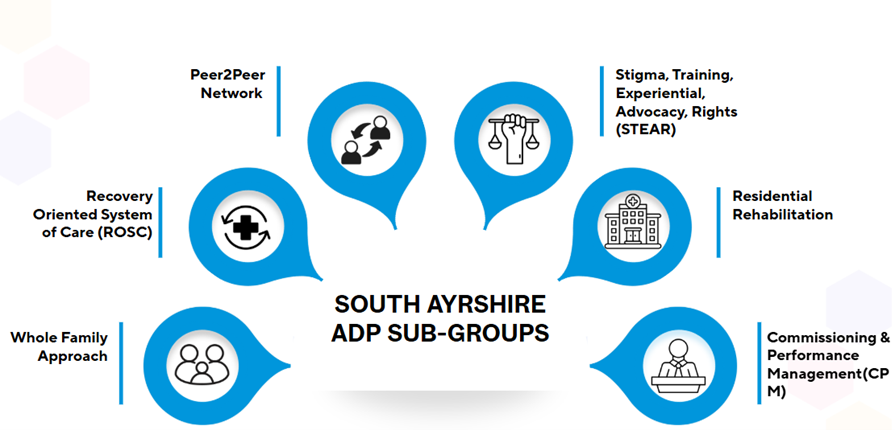
Each working group has joint chairs from both statutory and third-sector organisations. The chairs of each of these are ADP members with voting rights who represent the voice of their working group. Membership of the working groups are open to people with lived or living experience, their families, and others with relevant service experience. This ensures individuals they are involved in the review and development of services
Key Learning

Leadership and Partnership Commitment
Securing buy-in from leadership is essential to the success of embedding lived experience in the design and development of alcohol and drug services. Where senior leaders demonstrate visible support and allocate resources to ensure that lived and living experience engagement is embedded and sustained. Equally, commitment from the wider partnership is required to foster a culture of co-production across agencies.
Flexibility in Approach
A flexible approach is critical. Engagement methods should be adapted to suit diverse groups and changing circumstances. This may involve varying meeting formats, offering hybrid participation, or tailoring support to individual needs. Flexibility helps maintain inclusivity and ensures that lived and living experience is not tokenistic.
Valuing Lived Experience
Lived experience has intrinsic value and must be recognised as such. Compensation, whether through vouchers or other forms of support, demonstrates respect for participants’ contributions. Importantly, these resources should not be the first to be cut during budget pressures. Sustained investment signals that lived experience is a priority, not an optional add-on.

Support Structures
It is critical to create supportive structures for lived experience. This is to support each person’s wellbeing and support them to grow in confidence within their role. Peer networks, mentoring and reflective practice, along with appropriate support and supervision are examples of these.

Reflection
The partnerships should be prepared to pause, reflect, and invest in careful planning before implementation of changes to the ROSC. This reflective approach ensures contributions are meaningful and authentic.

Time
Embedding lived experience in the design and development of the ROSC requires time to build trust and understand the needs of the people involved.
Next Steps
South Ayrshire ADP have plans to embed further improvements to sustain and enhance elements of recovery, linked to wider outcome frameworks and guidance. These include:
- Ethical Commissioning framework: A person-centred, and human rights-based approach to service design and delivery with a focus on high quality care. In addition to involvement of lived experience throughout it also encompasses fair work practices.
- National Collaborative Charter of Rights for people impacted by substance use: To support services to understand the human rights belonging to people impacted by substance use and embed a rights-based approach throughout service design.
Get in touch
Please send us an email at his.alcoholanddrugs@nhs.scot if you:
- have a question about our programme or resources
- would like to speak to a member of our team about our work