
Stakeholder engagement
Senior management engagement
The leadership and vision of senior management is crucial to the sustainability of a new Early Intervention in Psychosis services. Senior leadership can support the long-term vision of how the service will work with other parts of the system, whilst maintaining Early Intervention in Psychosis as a standalone service.
Having strong support from clinical and senior management has enabled the Early Intervention in Psychosis pathfinder teams to address barriers to implementation, allowing them to test and adapt new ways of working to provide quality care.
Setting up an implementation group
It is important to have the core team (for example, the team lead and clinical lead) involved before any stakeholder engagement takes place. Having the core team involved can help develop service buy-in and enhance understanding of the Early Intervention in Psychosis ethos and vision with other stakeholders in the system.
The core team can also support planning with service leads around the staffing profile needed for the service, ensuring that staff have the right skills mix. The resources in the workforce planning section of the guide can support with considerations around staffing.
In the very early stages of considering Early Intervention in Psychosis, implementation groups may bring together staff with an interest in Early Intervention in Psychosis, alongside a wider network of stakeholders. This may include representatives from child and adolescent mental health services and third sector organisations working directly with people with lived experience of psychosis.
The pathfinder groups initially met every 1-2 weeks to discuss service setup and design. These meetings were attended by professions recommended in Early Intervention in Psychosis teams (mental health nurses, occupational therapists, psychologists, etc), as well as senior managers and colleagues from the third sector.
In addition to regular meetings, pathfinders also had dedicated time for learning and coaching sessions. Implementation groups can also be supported by service design and quality improvement input, with assistance from administrative support for note taking and scheduling. Access to an Microsoft Teams channel may also be beneficial to collate and share resources. A template that was used with the pathfinders in coaching sessions to guide conversation and understand challenges and mitigation is contained within resources.
Top tip: Implementation groups can smooth the transition between early planning/commissioning stages and later service delivery. As additional staff are recruited, they will be able to connect with the implementation group, who have knowledge and connections relevant to the locality
For your initial implementation group, there are a range of people that you may want to involve.
This can include:
- clinical directors
- head of psychology
- clinical psychology
- psychiatry
- GPs
- finance
- occupational therapist
- nursing
- administrator
- pharmacy
- primary care mental health nurses
- advanced nurse practitioners
- lived experience and third sector partners (including housing and benefit support)
Local quality improvement input will also be useful at this stage. Along with implementation groups, quality improvement input can support the design, testing, data and project management work that will be involved.
Stakeholder mapping
Once you have a core clinical team and senior level support, it important to consider who the wider stakeholders are for your Early Intervention in Psychosis service, and how you plan to involve them.
This is an activity where the implementation group can be consulted. Stakeholders in the third sector and people with lived experience of psychosis can be invited to join a lived experience reference group, or to contribute to the design of the servicein other ways.
The first step in engaging stakeholders will be to develop a clear picture of what is available in your local area. We would recommend a stakeholder mapping exercise, which “helps make all the various people and organisations that form part of the ecosystem, visible to the team”. This will help develop understanding of the interfaces between primary and secondary care services and third sector organisations.
By understanding the interfaces and support available in your area, you can better plan the skills needed in your Early Intervention in Psychosis team. For example, third-sector organisations may be able to assist with vocational, family, and substance use support, which can be factored in when calculating whole time equivalents for your team.
“We have worked well with third sector agencies and so far two people have successfully secured accommodation. One of these people had been sofa surfing which made it difficult to engage well with him in recovery and relapse prevention as his basic needs were in threat.”
Team Lead, CONNECT
It is important to identify key contacts within each organisation, capturing their name, role, contact information and any additional detail that might support conversations around Early Intervention in Psychosis. It is also helpful to capture a deputy contact if possible.
Prompt questions:
- What are the shared reflective spaces for learning within the health and social care partnership?
- Who are the people and services who will support and feed into the Early Intervention in Psychosis service?
- Who is your implementation team? This is a group of multi-disciplinary people who will meet regularly to plan the service and help get it to the launch stages.
Your wider stakeholders for engagement may include community mental health teams, inpatient wards, crisis, police, social work, GPs and, third sector partners.
Top tip: You will want to map out links of those in the implementation team, for example, a nurse who has come from crisis will have good insight into how this team works and be able to create a strong working relationship with this team.
Working with organisations in the wider system beyond the NHS is crucial for holistic support. These may include third sector organisations, universities, employment advisors, and housing. These can be identified in a stakeholder mapping session.
Top tip: Third sector providers/third sector interface have sometimes needed 3-6 months’ notice to be able to engage. It would be helpful to have a notice of interest at health and social care partnership or board level.
These groups require a championto educate on Early Intervention in Psychosis, and gain buy in to the service. The Early Intervention in Psychosis Network in Scotland has over 1,000 contacts and can assist with finding stakeholders in your area who have already engaged with early intervention in Scotland and who might be interested in taking a leading role in promoting Early Intervention in Psychosis.
Stakeholder Mapping Resources
Stakeholder mapping activity
This resource can help with understanding how to map stakeholders, as well as hints and tips for getting the best from this exercise
Early Intervention in Psychosis coaching session template
This resource is focused on service development, which can support thinking and discussion around developing an Early Intervention in Psychosis service, such as shared service vision, support needs, risks and mitigation.
Developing a communications plan
Once you have completed stakeholder mapping, it can be helpful to develop a communication plan which will:
- group stakeholders by their levels of interest and influence in Early Intervention in Psychosis (see activity section)
- identify what information will need to be shared with them,
- decide how often it needs to be shared and in what format.
Consideration of the most appropriate communication channels for young adults is also important, for example websites or text messaging. An example communications plan created by NHS Tayside is available in the resources section.
“It is good to be able to offer the right support at the right time as early as possible. The more people are hearing about our service, the more people we are seeing early on in the development of their psychosis.”
Team Lead, CONNECT NHS Tayside
Activity: Group stakeholders by interest/influence
Read more about and complete the stakeholder analysis prioritisation matrix, which will visualise stakeholders by prioritising them by influence and interest.
Communications plan resources
Communications and engagement plan
Create a communications and engagement plan through Turas, which will help plan out how to approach communication with stakeholders, the purpose of the communication and the frequency.
Paths to recovery webinar
Focuses on youth friendly approaches to social and vocational recovery after psychosis
ALISS
A local information system for Scotland, a directory to find services, groups and activities for health and wellbeing across Scotland
TSI Scotland network
A national network of 32 third sector interfaces in Scotland (one in each local authority). The organisations listed include charities, voluntary organisations, community groups, social enterprise and volunteers.
Engaging with service users, carers and families
The experiences and opinions of service users, carers and families are integral to the quality of the design and delivery of Early Intervention in Psychosis service. The purpose of engaging lived and living experience is different at the design and delivery phases of service development and this needs to be clearly defined to maintain engagement and to meet people’s expectations.
During the design and develop stages, people with lived and living experience can play a key role in stakeholder mapping and establishing the structure of the lived experience reference groups. Pathfinder lived experience groups were attended by people with recent experience of psychosis or people who had experience of caring for someone with psychosis.
Trust can be an issue with people experiencing first episode psychosis and for those who have had poor experiences with mental health services. Therefore building relationships with third sector organisations can be helpful in forming lived experience reference groups.
It is important that lived experience groups are independent of services, are able to develop their own terms of reference and are able to formalise the communication between themselves and other groups/services. This will ensure that lived experience groups provide a safe space for people with lived experience and living experience and third sector colleagues.
People may have had or may still be receiving treatment from clinicians involved in implementation groups or services, so it is important to carefully consider the interfacesand how communication is managed between groups to ensure impartiality, confidentiality and the safety of participants.
Top tip: At the early stage of establishing an Early Intervention in Psychosis service, it can be hard to locate people with first episode psychosis. However, it is of benefit to have diverse representation within the local lived experience reference group, for example younger people, LGBTQ and black and ethnic minorities.
If available as a resource within your local area, it may be beneficial to employ a peer engagement worker. This was the approach used in the Early Intervention in Psychosis programme, and the peer support worker had a key role in linking the lived experience and the implementation groups.
Once services have been operational for a while, current service users, family and carers, in addition to previous service users can join the group to share their recent experiences.
Top tip: The preference of people involved in lived experience groups has been to maintain a separate space or group that then links in with the local implementation group. This supports wider involvement of lived experience by maintaining a safe space for people to contribute their opinion and experiences.
“[People experiencing first episode psychosis] can be worried that they’ll be put in hospital and maybe not let out again in a hurry. It’s about building up that relationship early on so that when people come into our service, they can be honest in their conversations and willing to take on board the Early Intervention in Psychosis model.”
Key Worker, Dumfries and Galloway
It can take a substantial amount of time and resources to create lived experience groups, and not all areas of Scotland will have lived experience networks. Cultivating and strengthening relationships with third sector organisations within your local area can help ensure that there is lived experience involvement in the development of your service.
Prompt questions:
- To what extent is the Health and Social Care Partnerships already set up to support engagement with people with lived experience?
- Are there local examples of good practice within your Health and Social Care Partnerships?
Lived experience engagement resources
People with lived experience of psychosis views and experiences
As well as their family members and carers around what matters most to them in the design and delivery of Early Intervention in Psychosis services in this report from Change Mental Health
NHS Dumfries and Galloway: Lived Experience Reference Group Terms of Reference
NHS Dumfries and Galloway: Patient information leaflet for behavioural family therapy
Scottish Recovery Network: Engaging with people with lived experience top tips
The link also provides access to a case study produced by the Scottish Recovery Network around the experience of the lived experience reference group in phase one of the Early Intervention in Psychosis programme.
Scottish Government and COSLA: Community engagement and participation guidance
This resource focuses on planning with people and how NHS Boards, Local Authorities and Integration Joint Boards should meaningfully involve people and communities in the planning, design and redesign of health and social care services in this document from the Scottish Government and COSLA
VOiCE National Standards for Community Engagement
Scottish Human Rights Commission: The Human rights-based approach
This resources looks at the human rights-based approach and includes videos on the PNAEL Principles from the Scottish Human Rights Commission
VOX Scotland: Making Co-production Work
This resources looks at making coproduction work in this lived experience-led resource, developed to help mental health professionals and service providers implement meaningful co-production in policy, service design and improvement work developed by Vox Scotland.
Quality Framework for Community Engagement and Participation
Recommendations and guidance from Healthcare Improvement Scotland and the Care Inspectorate Quality Framework for Community Engagement and Participation, including how NHS Boards, Local Authorities and Integration Joint Boards can assess and improve how they engage with people and communities.
Designing the service
The Scottish Approach to Change can support the design work for your Early Intervention in Psychosis service. This approach brings together a range of change methods into a unified approach, translating theory into a practical tool for change. The length of time of each stage and the intensity of activity can vary considerably.
When starting from scratch with a new service, the identify and understand phase may take place over a longer period. The resources contain tools that can support the design of services. The diagram below displays the eight steps of the Scottish Approach to Change.
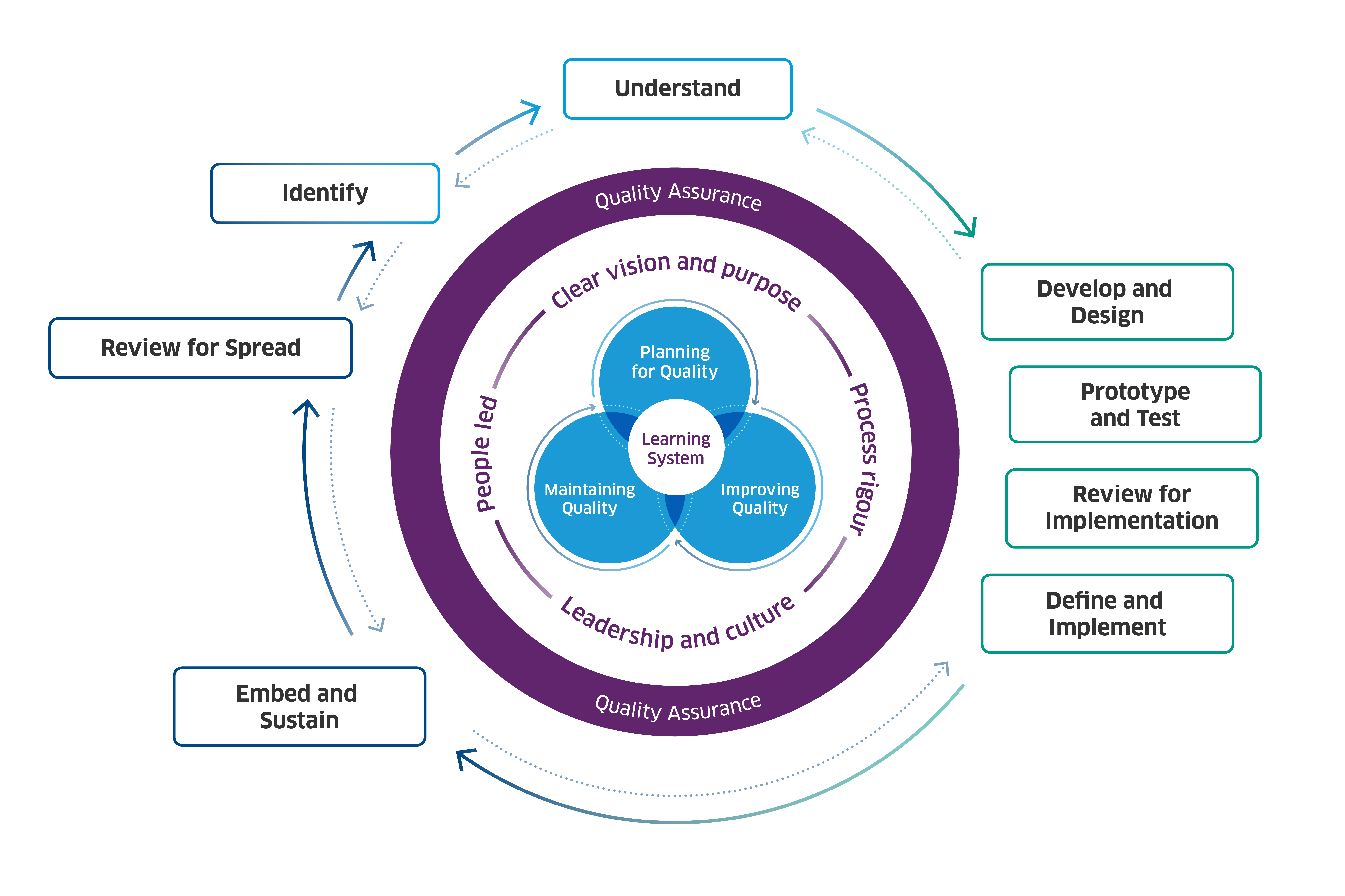
The initial stages, as shown in the diagram above is to identify and understand the problem. In Early Intervention in Psychosis, it can be helpful to ask: what are the current journeys and experiences of people presenting with first episode psychosis in your area?
It can be helpful to track service user journeys through the system, including waiting times. For examples from other areas, see the user journey maps in the resource section. Applying service design tools will allow you to embed user experience in your own Early Intervention in Psychosis pathways.
Service design should take place with input from people with lived experience and colleagues in the third sector, to ensure that service user experience and needs underpin service delivery.
Activity: Development of personas
The development of personas can help to design an inclusive service which does not exclude individuals based on their individual characteristics. Creating personas can provide services the opportunity to reflect on the diversity of their area, and to consider what additional needs their service may be able to serve.
Personas are descriptive fictional profiles of people’s lives that can help teams consider the needs of groups users who share common characteristics. Development of personas is best done in a group setting, ideally with your implementation group to help teams empathise with service user groups.
Personas provide a reference point throughout the design and development process, helping teams focus on the real needs and experiences of service users rather than relying on assumptions or stereotypes. This is particularly important when designing person-centred care.
Prompt questions
- What knowledge or evidence is available about service users in your local area? You can use both qualitative and quantitative data when creating personas
- Which stakeholders should you speak to in order to gather evidence to base your personas on?
- What method of data gathering would be most effective – focus groups, workshops, in-person vs virtual?
- What are their motivations and frustrations? What are their short and long-term ambitions?
- Consider the more specific needs of people experiencing first episode psychosis and their families: will they have received the support they need? Have they had employment, benefits, and vocational support? Has the family received the support and education they need?
- How would they like to communicate?
Activity: Map a service user’s journey to understand and visualise their experience of accessing and moving through the service
This is the process of creating a visual representation of the steps your user takes in using your service to achieve their goal.
User journey maps are useful at every stage of the design process, with particular relevance for Early Intervention in Psychosis services looking to understand the interventions they would like to prioritise, where links to other services should be made and which ones to prioritise. They can also act as a precursor to further system or stakeholder mapping.
Journey mapping and persona resources
Early Intervention in Psychosis service models
There is a strong evidence base for two service delivery models: a specialist standalone service, and a hub and spoke service. Both models can be flexibly applied to rural areas.
The Early Intervention in Psychosis national programme tested a bespoke Early Intervention in Psychosis service model in a rural setting in Dumfries & Galloway and the development of an Early Intervention in Psychosis hub in Dundee City.
Within the Early Intervention in Psychosis programme, the primary considerations for service model selection were geography and population. Significant travel times, uneven demand and isolated communities can create challenges for service delivery. However, the two primary service models can be flexibly applied and are appropriate for most geographic and demographic contexts.
Service model algorithm
- Urban: Specialist service model
- Rural (population of more than 250,000): Hub and spoke model
- Rural (population of less than 250,000) Bespoke model
- Island (population of less than 30,000): Pathway model

The service model algorithm tool is shared in the resources. This will be helpful when considering the suitability of service models and characteristics of your board. Service models will also be influenced by other factors such as availability of resources.
Scotland’s geography may warrant bespoke Early Intervention in Psychosis service models in geographically dispersed areas. Rigorous data collection will be critical to ensure these models deliver the evidence-based interventions that improve outcomes for people experiencing psychosis. It is also important to consider the ways your area might change over time.
Caseloads will increase with the growth of the service and then continue to change over time due to the length of time people stay in the service, natural population growth and improved referral and identification processes.
Prompt questions
Local context will strongly influence selection of the right service delivery model for each area. When considering a service model, you may want to consider asking the following questions:
- What percentage of your population are under 35?
- What is the population density of your area? What is its size? How long does it take to travel from one border to another?
- How rural or urban is your area?
- What is the current staffing profile in your area?
- What is the availability, range and location of existing mental health services? Where is the location of inpatient services?
Developing early intervention in psychosis service models resources
Watch the webinar by Dr Karen O’Connor
Workforce planning
Recruiting to the Early Intervention in Psychosis team
To establish an Early Intervention in Psychosis service, the minimum recommended workforce is a team lead, a psychologist, and a key worker. Roles such as a peer support worker, healthcare support worker and an occupational therapist are beneficial once the caseload has built up within an established core team, while additional mental health nurses are necessary if you’d like to increase your maximum caseload.
Lower caseloads are expected when services launch initially, during this time the team lead can support service users (depending on professional background) and provide additional capacity within the team.
Having experienced staff is beneficial, for example a key worker who has previously worked within child and adolescent mental health services and is familiar with working with families. Similarly, peer support and healthcare support workers with knowledge and links with local groups are also valuable.
A background of working with psychosis is recommended (but not essential) for staff working in the service, as this can facilitate the promotion of the service, and support identification of cases. In Dumfries & Galloway, the clinical psychology staff have worked in both Early Intervention in Psychosis and inpatient wards, where attending the inpatient multi-disciplinary teams’ meetings has enabled them to actively identify appropriate cases for Early Intervention in Psychosis.
Adoption of service models will be dictated by your local population and the number of staff required for your service. To maintain fidelity to the Early Intervention in Psychosis model, key worker caseloads should be capped at approximately 15 cases per key worker.
Depending on practices in your board area, you may be required to book sessional psychiatry time in advance, which makes forward planning and sufficient administrative support important.
Additional prescribers beyond psychiatry colleagues are a useful asset to Early Intervention in Psychosis services. This allows for greater flexibility and reactivity to respond to medication changes. The side effects of some antipsychotic medications are a known factor in service user disengagement, so you may want to look at hiring staff, such as clinical pharmacists, who can handle most prescribing within a service.
The resources include a set of slides developed by Dr Rajeev Krishnadas. They provide useful guidance and should be used alongside the National Institute for Health and Care Excellence prescribing protocol for first episode psychosis and Early Intervention in Psychosis Network Quality Indicators for Early Intervention in Psychosis (2025).
“Even if not directly involved in the care of somebody, I still like to know about what’s happening in their care and am able to provide some support to thinking about people in a psychological way.”
Consultant Psychologist, Dumfries & Galloway
Required roles
The typical roles required as part of a full Early Intervention in Psychosis multidisciplinary team are:
- Team lead
- Key workers (registered mental health nurse, occupational therapists or social workers)
- Clinical psychologist
- Consultant psychiatrist
- Occupational therapist
- Administrator
- Peer support worker
- Healthcare support worker
Role descriptions used by the pathfinders are available in the resource section. These roles may vary between health boards due to availability of staff. This may also be impacted if your service is using staff that work in another service/team alongside their role in the Early Intervention in Psychosis service. If you are recruiting externally, you may need to factor in additional time for recruitment. For example, a clinical psychologist may take up to 6 months to recruit, once their notice period has been factored in. Some points for consideration are given below:
- Is there someone who would be keen to lead a new specialist team?
- Can you identify staff who already have psychosis in their remit, or worked with families or young people?
Activity
Watch the webinar by Dr Kathryn Greenwood, on the role of the lead practitioner and engaging young people in Early Intervention in Psychosis Services in England.
Top tip: A shared understanding and clarity of role responsibilities is important within a small team, where team members may take on tasks outside of their typical role. Role descriptions are included in the ‘Essentials of Early Intervention in Psychosis training module, and descriptions from Esteem Early Intervention in Psychosis are available as a resource in this guide.
Having part-time or sessional input for psychiatry staff means that careful consideration is needed as to when input is of most value to the team. NHS Tayside initially co-ordinated a single session of psychiatry input to coincide with the weekly Early Intervention in Psychosis multidisciplinary team or family meeting, and alongside this identified clear pathways for escalation or support outside of the agreed time available.
These roles are most effective when dedicated, protected time is allocated to each position. It can be difficult to maintain the Early Intervention in Psychosis ethos and provide the level of input required if staff, such as key workers, are also managing large caseloads in other services, for example community mental health teams.
Medication, Prescribing and Early Intervention in Psychosis job description resources
Staff training needs
Public Services Delivery Scotland have developed an Essentials of Early Intervention in Psychosis Module, which covers the core components of Early Intervention in Psychosis. This should be completed by all staff.
There are four tiers of training levels for staff working within early intervention for psychosis:
- Specialist: Diploma in Cognitive Behavioural Therapy, CBTp
- Enhanced: Psychosocial Interventions for Psychosis (PSIp), Enhanced Psychological Practice Programme (EPP-A)
- Skilled: Essentials of Psychological Care, Early Intervention for Psychosis
- Informed: Essentials of Psychological Care: Early Intervention for Psychosis (EIP)
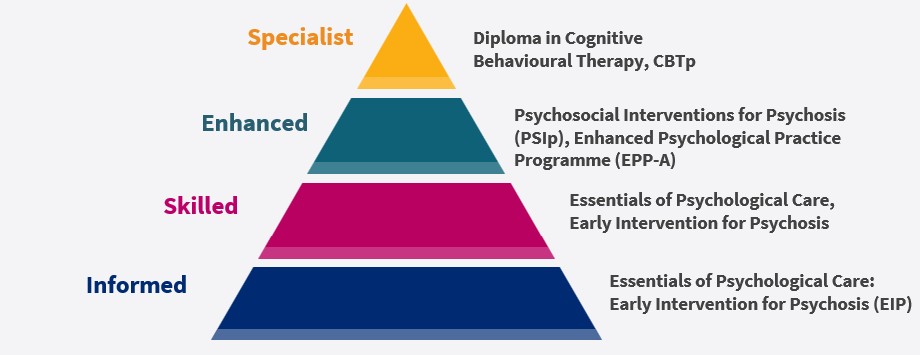
The resources contain further information around training available through Public Services Delivery Scotland.
The Royal College of Psychiatrists Early Intervention in Psychosis Network Quality Standards (2025) set out the training requirements for Early Intervention in Psychosis services across the UK and Ireland. The training needed will depend on the skills and experience already available within the team. As a minimum, staff should have knowledge and skills in working with young people, families, and substance use.
All keyworker and psychology staff will need trained in Psychosocial Interventions in Psychosis and Behavioral Family Therapy. It is currently difficult to source Behavioral Family Therapy training in Scotland, and this may pose a challenge for teams in some areas. Public Services Delivery Scotland are currently looking at how to make Behavior Family Therapy training more accessible in Scotland, as at present it is only available through Meriden.
Psychological therapy staff will also need training in Cognitive Behavioural Therapy for Psychosis. All staff will need essential training, for example risk assessment relevant to their organisation.
The resources contain slides from Public Services Delivery Scotland that cover psychological therapies and interventions for psychosis.
Prompt questions:
- How are you capturing information about current workforce training?
- What proportion of staff have training as outlined above?
- What training gaps do you have?
Activity: All Early Intervention in Psychosis teams to complete the Public Services Delivery Scotland Essentials of Early Intervention in Psychosis.
You will also need to identify any training gaps and link staff in with Public Services Delivery Scotland for available training.
Early Intervention in Psychosis Training Resources
- Complete the Essentials of Early Intervention in Psychosis training, developed by Public Services Delivery Scotland
- Read more about Meriden resources for family work in early intervention in psychosis
- Read more about psychological therapies and interventions for psychosis from Public Services Delivery Scotland
- Watch the recording and view the slides of a presentation at our recent Early Intervention in Psychosis Community of Practice webinar from Anne Joice – Director of Psychological Therapies, Public Services Delivery Scotland.
Multidisciplinary team working, leadership and governance
Early Intervention in Psychosis services are built on a multidisciplinary approach that values the contribution of all team members and promotes a holistic understanding of service users and their family. Leadership is shared across the team, with key leadership responsibilities provided jointly by the team lead, psychology, and psychiatry.
Clinical psychology provides clinical leadership through formulation-based care planning and risk management, fostering team development and compassionate practice, and guiding service improvement in line with strategic objectives, feedback, and data.
Due to the current national shortage of psychiatrists, pathfinders have needed to adapt and innovate to be able to gain psychiatry input. NHS Dumfries & Galloway use a shared care model, working with the designated psychiatrist within each community mental health team. It has been useful for the team to have administrative support to allow assessments to be booked when each psychiatrist is available. The team have arranged input from a clinical pharmacist who attends the multidisciplinary team meetings and is able to discuss medication with service users. urther details on how NHS Dumfries and Galloway adapted resources to address this challenge can be found in the case study included in the resources section.
NHS Tayside have adapted with sessional input from a consultant psychiatrist and a Specialty Trainee (Year 6) doctor to cover the weekly multidisciplinary team meeting, with some additional time for formulation, service user appointment, or family/professional meetings, depending on the needs of the service..
Prompt questions:
- Is there someone who would be keen to lead a new specialist team?
- Can you identify staff who already have psychosis in their remit, or worked with families or young people?
NHS Dumfries and Galloway Early Intervention in Psychosis Clinical Pharmacy Case Study Resource:
Read the NHS Dumfries and Galloway access to clinical pharmacy case study.
Finding the right location for the service
Staff working within pathfinder sites have found it helpful to locate their base near to other services they work with, for example Child and Adolescent Mental Health Services and Community Mental Health Teams. This helps to build awareness of the team and build on existing relationships, resulting in faster responses to queries and referrals.
Although the service primarily visits people within their own homes or within the community, learning from ESTEEM has shown that it is helpful to place the team base in a non-stigmatising location, for example away from the inpatient unit. In NHS Tayside the Early Intervention in Psychosis service base is located within the community hospital alongside clinics such as optometry and podiatry. In NHS Dumfries & Galloway the team is based in the main health centre for the area.
Consideration should also be given to a central accessible location, to reduce staff travel time when on home visits. In rural settings such as Dumfries & Galloway, travel time for key workers is considerably more than it would be within an urban or semi-rural area and should be factored in when considering the amount of face-to-face contact planned for service users.
Key workers would typically meet service users and families within their own homes. There have been very few occasions where a virtual tool such as Attend Anywhere or Microsoft Teams have been used by pathfinders. As Early Intervention in Psychosis services are formed around relational and attachment theories and principles, seeing service users and families/carers in person is recommended as the first preference. It would therefore be useful to consider:
- Staff access to a car (carpool or staff members own car)
- Budget to cover travel expenses
- Devices such as mobile phones to keep staff member in contact with someone at base
- Laptops are useful especially for key workers on home visits
- Impact of travel time on caseload capacity
Resources
Scottish Fidelity Tool